Welcome

Welcome, nau mai, haere mai!
Come on in and stay a little while. . . you never know what you might find!

Saturday, March 19, 2011

Fold. . . a thousand paper cranes for Christchurch and Japan

Paper cranes I folded yesterday, some with flapping action.
My heart goes out to all those suffering in Japan after the magnitude 9.0 earthquake on 11th March. The proportions of the disaster just defy belief, and the tv footage is so disturbing - how on earth can people muster strength to survive an earthquake, tsunami and nuclear disaster, when any single one of those would be a catastrophe in its own right?

I imagine many of you are familiar with the story of 1000 paper cranes, but for those who aren't - here's a brief outline.

There is an ancient Japanese story which says that if anyone manages to fold 1000 origami paper cranes, they will be granted one wish by a crane. Sadaki Sasako was only two years old when the atomic bomb was dropped on Hiroshima, near her home by Misasa Bridge in 1945. Over the years she became sick and was eventually diagnosed with leukaemia. She was hospitalised in February 1955 (aged 12) and given a maximum of a year to live. A friend of hers visited her in hospital and gave Sadaki a golden paper crane she had folded. This reminded Sadaki of the ancient Japanese story. Sadaki decided to fold 1000 paper cranes, hoping that then the crane would grant her wish to be well again. Sadly, Sadaki died on 25th October 1955, and stories vary as to whether she finished her 1000 cranes or not. Her story lives on and there are statues of her holding the original golden paper crane in the Hiroshima Peace Memorial and Seattle Peace Park. There is a plaque at the base of the statue in Hiroshima Peace Park that reads: "This is our cry. This is our prayer. Peace on Earth."

The picture below is from the Wikipedia Creative Commons.
Statue of Sadaki Sasako in Seattle Peace Park
I have decided I will fold 1000 paper cranes as a wish that people in Japan, Christchurch and disaster zones elsewhere in the world will find peace in their hearts and the strength to carry on and rise up from the ruins and incredible suffering around them. I will be sending positive thoughts to all those affected in Japan and Christchurch as I fold. Once they are finished, I plan to string the 1000 cranes together and give them to the King's Language School in Christchurch (where 68 overseas students, and 9 staff died in the earthquake, in the collapsed and fire-riddled 6 storey CTV building) My aim is to let them know that people elsewhere in the country (and the world) are thinking of them, by using the 1000 cranes as a metaphor for offering hope and a wish for a peaceful future. Many of the lost students at King's Language School were Japanese, but regardless of ethnicity, I hope the thought will be appreciated. Here's a link to the names and nationalities of all those from King's Language School missing/dead in the earthquake. It is so sad to read all those names and think of all those young people so far away from their homes and loved ones when they died. As a mother and as someone who lives a world away from her family of birth, that really gets to me. . .

In fact, of course, the whole situation and ALL the deaths really get to me, and this is just one little thing I want to do to help, to send thoughts, aroha (love) and strength to all those affected. It may be a very small thing, but it's all I can do, having already given what I can monetarily to the earthquake relief funds. I just hope it will be well-received. I have no fixed time limit in mind, just as soon as I can fold/gather 1000 cranes and get them threaded together, I will deliver the cranes to Christchurch. It's approximately 5.5 hours drive away - perfectly do-able with an overnight stop.

If any of you reading this would like to send me some paper cranes to help make up the 1000 I would be delighted. It doesn't have to be fancy paper, anything will do (even junk mail!), but please make sure the squares you start with are at least 15 cm square.


Here's a clickable link to a pdf of illustrated instructions to make an origami paper crane.
For those of you who don't know me personally, please contact me at yarnificationz (at) gmail (dot) com and/or with a comment below and I will let you know where to post those cranes. . .

If by a small miracle I end up with over 1000 cranes thanks to all of your generosity, then I will start folding and collecting the next 1000 cranes to send to a pre-school or school in Japan which has been badly affected.

By the way, I first heard of the story of Sadaki and the 1000 paper cranes back in the early 1990s, by way of a song entitled "Cranes over Hiroshima" from American folk singer Fred Small. The lyrics and guitar chords can be found here.

Wednesday, March 16, 2011

Love. . . my dog, as much as I love you!

"A dog is a boy's best friend" Sonny Jim and Frodo, Oct 2010
The song "I love my dog" by Cat Stevens is one of Sonny Jim's all-time favourites. The main repetitive lyric is "I love my dog. . . as much as I love you!" It's pretty much how we all feel in our little family - the dog, Frodo, is as much a part of the family as the rest of us and we all love him very much. Sonny Jim says Frodo is his "fur brother" and that Frodo is his "brother from another mother!" They are often both to be found rolling around on the floor together and Frodo sleeps in Sonny Jim's room . . . on his own bed, or on Sonny Jim's! When Wifie says "I love you my darling" I have to look at her to see whom she is directing her comments to. . .  more often than not it's the dog!!

Hope you enjoy these photos of Frodo and us :-)

Frodo with me the day we got him - 12th Nov 2009


Wifie with fluffy puppy Frodo  - November 2009

Frodo meets an alpaca for the first time - Dec 2009

Sonny Jim with his "personal tissue" October 2010

Wifie and Frodo have a swim in the sea - January 2011

Saturday, March 12, 2011

Knit. . . the never-ending fish blanket

The first few fish, May 2008.


This started out back in May 2008, after I found the "recipe for fish" on ravelry. The tessellated fish vaguely reminded me of an M.C. Escher design and I had recently started knitting socks so I was sure I would have plenty of sock yarn scraps to use up over time. I decided to have "dark" fish swimming one way and "light" fish swimming in the other direction. Thus began my lengthiest knitting project to date! After the first few fish I had the pattern memorised and I soon discovered it was the ideal "travel knitting" project. I packed a small plastic box with a few scraps of sock yarn, a couple of wooden 2.5 mm dpns and an old dental floss container for cutting the yarn. This "Emergency Knitting" box accompanies me almost everywhere, just in case I get a chance to squeeze some knitting into my day e.g. whilst waiting at the Dr's or dentist's or as a passenger during a lengthy car journey. I can even take my "Emergency knitting" on domestic and international plane journeys and do a little in-flight knitting, as my kit meets most airline regulations! The wooden dpns are little more than toothpicks and I don't need scissors to break the yarn thanks to my trusty dental floss container!

This is the blanket at the moment:

To be honest, I am starting to tire of knitting fish and yearn for a different little travel knitting project. But I won't give up till I have finished. I have promised myself that I will get the interminable fish blanket finished in 2012, as part of the "12in2011" group challenge on ravelry.

As of today I have 254 fish, of which 185 are sewn on so far and 69 swimming free. . . 
The blanket is 10 fish wide by 18 fish tall, with the 19th row half completed. 
My aim is for the finished blanket to be 14 fish wide and 24 fish tall, but I may alter that as the end of the year approaches. Current plan is to have a border of rainbow and undyed fish all the way around and Wifie has started helping to knit the rainbow fish for me - for which I am eternally grateful.

I will update you on my shoal of fish later in the year. . . and in the meantime if anyone reading this has any scraps of sockyarn they would like to donate to this blanket, please let me know at yarnificationz (at) gmail (dot) com 
Thanks :-)

Friday, March 11, 2011

Eat. . . Chocolate Zucchini Cake

Here's one I prepared earlier. . .
This is the perfect treat food for those times when you are inundated with zucchini/courgettes, and it is a good way to use up "the one that got away" - ie the zucchini which somehow managed to fly beneath the radar and evade capture until it was the size of a newborn baby! It's also a good way of getting vegetables into unsuspecting children, although I have to admit that any health benefits from vegetable consumption are out-weighed by all the fat, sugar and chocolate involved! Just a tip, the first time you present these to small children, don't mention the zucchini! Years ago, when I first told Sonny Jim about the new recipe I had found, he said something along the lines of "Ewwwww, gross!!" A few days later when I told him there was "chocolate brownie" for afternoon tea he ate it delightedly. Only afterwards did I confess it was in fact the dreaded "chocolate zucchini cake" and he has loved it ever since!

The recipe is from the book "School lunches and after school snacks" by Alison and Simon Holst. I often make a double mixture and freeze most of it for occasional lunch box or afternoon tea snacks. . .

Yummy Zucchini Chocolate Cake

125 g butter/margarine 
1 cup brown sugar
1/2 cup white sugar
3 large eggs
1 tsp vanilla essence
1/2 cup yogurt - any type
2 1/2 cups plain flour
3 cups/ 350 g grated zucchini
1/4 cup cocoa powder
2 tsps baking soda
2 tsps cinnamon or mixed spice
1/2 tsp salt
1/2 cup chocolate chips 

Heat oven to 170˙C. Line bottom and sides of 25 cm square brownie tin or roasting pan, with two crosswise strips of baking paper.
Beat softened butter and sugars in mixer or food processor until light and creamy. Mix in eggs, vanilla, yogurt and 1/2 cup of measured flour, then mix in grated zucchini. Sift in remaining flour and next 4 ingredients. Stir gently, then pour into the tin. Sprinkle with choc chips. 
Bake for 45 mins, or until centre feels firm and skewer comes out clean. Cool on rack in tin. Refrigerate or freeze wrapped pieces. 
(Or put a load of slices in an ice cream tub and bury in the chest freezer!)

I'd love to hear how you get on if you try it!


Tuesday, March 8, 2011

Love. . . is a fearsome thing!

 "Love is a fearsome thing
It pays no mind to the colour of your skin or your gender
Love is a power so fierce and tender
Flies on its own sweet wing
Oh, love is a fearsome thing."

That's the chorus from the song "Love is a fearsome thing" by Australian folk singer Judy Small. It's not my favourite Judy Small song by any means, but it is one that whirrs around in my head from time to time, maybe because it is so relevant to my own situation! You see, I'm the "rainbow sheep" of the family:


Photo courtesy of 14 rainbows in strange places

Anyway, I just wanted to send a bit of love to my family - both to my lovely wife and son, and to my parents and extended family, many of whom I don't get to see very often as we live on opposite sides of the planet - but guess what? I love you!!!

Tragic events like the recent Christchurch earthquake remind you that there is nothing as important as the people that you love. My all-time favourite Māori proverb (Whakataukī) echoes this sentiment. . .

"He aha te mea nui o te ao?
 He tangata! He tangata! He tangata!"

"What is the most important thing in the world?
It is people! It is people! It is people!"

Sunday, March 6, 2011

Knit. . . Premature baby stuff for CHCH, plus a bit about Pēpi Pods and traditional wahakura

A bit of "charity knitting" today. . .
One of the lovely women at Nelson Knit Night (we shall call her "C") has contacted Nelson Hospital Special Care Baby Unit (SCBU) to ask if the Christchurch Neonatal Unit might be needing some woolly hats and bootees for the prem babies down there. The answer was yes, as due to all the stress caused by the earthquake they are expecting more premature births than usual in the Christchurch area. Thus the call went out to our little band of knitters/crocheters. "C" has offered to courier the knitted goodness down to Christchurch once she has gathered enough items together. Wifie and I have knitted 3 pairs of bootees between us so far and I have started on a ribby hat.
Bootees by Lulu at the back, mine at the front. . .
Meanwhile, I told my mum over in the UK what we were up to and she has decided to donate a big bag full of prem-size baby bootees to the Christchurch Neonatal Unit as well! Alongside all her other knitting, mum usually knits enough tiny bootees until she fills a large tin with them and then donates them to her local SCBU, but this time it's the babies of CHCH who will benefit. "Love knitted into every stitch" as the saying goes in our family! I am planning to knit a few more hats and Lulu is part way through a pair of bootees, then I will give it all to "C" to send down to Christchurch. it's a small gesture, but hopefully one that will offer a little comfort to some of the most vulnerable babies in Christchurch.

Talking of vulnerable babies in the Christchurch area, I recently came across an appeal for sponsorship of "Pēpi Pods" for Christchurch, on the website Change for our Children. A Pēpi Pod is a protected space for babies to sleep in during their first months of life.
Baby in Pēpi Pod.
The primary purpose of a Pēpi Pod is to reduce the incidence of Sudden Unexpected Death in Infancy (SUDI) in babies most at risk. Babies considered most vulnerable to SUDI include those born prematurely, those exposed to smoke in utero or after birth, babies who are not fed breast-milk (whether expressed breast milk or directly breastfed) babies of low birthweight and those not placed on their backs to sleep.  From the website link above: "The pepi-pod is such a space for more vulnerable babies who need to be close to a parent AND safe when they sleep. . . The Pepi-Pod is a low-cost 'safe sleep' option for more vulnerable babies (those who bed share with mothers who smoked in pregnancy). It is expected, in time, to be more readily available, so that all babies have the opportunity for protection during sleep. Pepi means 'baby' in Maori and of course a pod protects seeds during a vulnerable time for a plant."
Photo above taken from Sunday Star Times article 16.11.10


There is also a traditional safe sleeping space for babies in Māori culture and this is known as a wakahura. It is a hand-woven flax/harakeke "bassinet" or "Moses basket" for babies up to 5 or 6 months of age. It is portable and provides a safe space for baby to sleep, returning to a traditional Māori way of sleeping babies. Wahakura roughly means "Something to carry a precious baby." The picture below is taken from the Canterbury Breastfeeding Network website.
Safe bed-sharing with a wahakura

 With both the wahakura and the pēpi pods, it is essential that safe sleeping rules are also followed.


For anyone interested, the cost of sponsoring a complete Pēpi Pod is NZ$46, but they are also looking for people who are able to sew covers to the specified measurements, and the dimensions are given on the website. Please follow this link.


Thursday, March 3, 2011

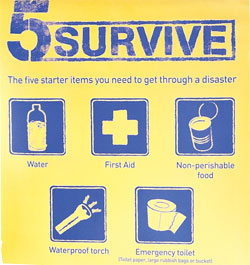
Civil Defence Emergency Kit

Image from Auckland City Council Website
In light of the recent deadly earthquake in Canterbury, I decided it was time to haul out our emergency kit and assess the situation. The government have long been pushing the idea that every household should have enough water, food and other essentials to be able to survive at least 3 days on their own in the event of an emergency. For years they have had adverts on tv to remind you to assemble your kit and "Be Prepared" (sure I have heard that motto somewhere back in my Brownie/Girl Guide days?!) . They also have a handy-dandy website: "Get thru" which advises you how to prepare for earthquakes, tsunami, floods, volcanos and landslides. Aaahhhh the joys of living in a geo-thermally and tectonically active country! Most school holidays, "Sonny Jim" and I have spent a couple of hours assembling a basic emergency kit, which we have gradually added to over time. So when I pulled our emergency kit out, this is what I found:
Emergency survival kit, as at 28th Feb 2011
A box containing non-perishable food, can-opener, cutlery, plastic plates and cups, a Trangia meths-burning stove, pans and matches;
a box full of bottled drinking water;
a box of general stuff such as toilet roll, candles, matches, silver foil emergency blankets, an emergency survival and first aid book, first aid kit, dynamo torch, solar/dynamo torch & radio combo, sunscreen, medication, dust masks, hand sanitiser gel, whistles etc;
a porta-potty (chemical toilet) with big bottle of "Loo blue";
even some dog food and spare dog lead (hand-knitted glow-in-the-dark lead at that!!) and an additional 15 litre yellow "Get ready, get thru" container of drinking water.

Not a bad start, but I decided we needed to upgrade our kit and move it off the deck (where it was getting a bit of a battering from the elements) and bring it inside where I knew it would be safe from the weather, but still easily accessible. So, first step was to clear out a corner of the laundry, which is right beside the main entrance to our house. Once that was done, I brought the boxes inside one by one and sorted out the contents, plus added extras. The survival food box is now absolutely brimming with rations. . . here are the contents before I put them in the box again:


I have since added some more extras like 500g of long grain rice, some instant noodles, a small bottle of cooking oil, some rolled oats and jars of peanut butter and honey. I could barely get the lid on the box, and the instant noodles are languishing beside the box now as there was no way they were going to fit! Maybe I'll just have to add a 4th box! Especially considering I haven't yet got any wool or knitting needles in the emergency kit - and they are absolutely essential items if I am to have any chance of remaining calm! "Keep Calm and Carry Yarn!" is my new mantra, remember!!

Apart from supplementing the food and cleaning and checking everything else, the other big jobs concerned water. I replaced all our drinking water, and counted 48 litres in total. The government advises you should have at least 3 litres of drinking water per person per day, so for our family of three we would need at least 27 litres. So we're well in there! I also added another 60 litres of non-drinking water, 45 litres of which is in a big old plastic container which in my view is unsuitable for storing drinking water, but perfectly adequate to hold water for doing the dishes etc. Finally, I put the entire kit (except the outdoor non-drinking water) into its new home in a corner of the laundry, et voila! Still a few things I would like to buy, like water purification tablets, eye goggles for each of us & some sturdy leather gardening gloves to help protect our hands when shovelling silt etc. I still need to add our sleeping bags and a change of clothes for each of us to the ever-growing stack of emergency kit boxes in the laundry. But hopefully we are more prepared than previously if the worst should ever happen right here, literally in our own backyard. . . If it happens when we are elsewhere then maybe all my preparations will be for nought, but I still think it is well worth doing.